
Introduction: From Agriculture to Bioeconomic Opportunity
The Caribbean has long been defined by its agricultural potential—fertile soils, favorable climates, and a biodiversity that has supported generations. Yet despite these advantages, much of the region’s agricultural activity remains centered on primary production, with limited integration into higher-value systems.
What is often overlooked is that Caribbean plant life represents more than food production—it represents chemical complexity, biological intelligence, and untapped economic value.
Plants are not merely crops. They are phytochemical systems, containing compounds with applications in medicine, cosmetics, nutrition, and industrial processes. Globally, these compounds are studied, refined, patented, and commercialized. Within the Caribbean, however, this layer of value remains largely underdeveloped.
To move forward, the region must transition from agriculture as production to agriculture as research-driven economic infrastructure.
Historical Context and Psychological Barriers
Any serious discussion of agricultural development in the Caribbean must acknowledge a deeper reality: the historical legacy of plantation-based systems continues to shape modern perceptions of agriculture.
For generations, agricultural labor was associated not with opportunity, but with imbalance—where effort and reward were disconnected. This has left a lasting psychological imprint, where agriculture is often viewed as labor-intensive and low-return.
As a result, many gravitate toward sectors perceived as offering more immediate reward, such as tourism and services.
This is not a lack of ambition. It is a rational response to inherited experience.
However, this creates a challenge:
If agriculture remains framed as it was historically, it will continue to be avoided.
From Emancipation to Economic Activation
The foundation of land ownership in the Caribbean, particularly within systems such as the Harbour Island Commonage, is rooted in the post-emancipation period.
Following the abolition of slavery, land grants issued under Crown authority provided access to land for formerly enslaved populations and their descendants.
This represented more than ownership—it represented an opportunity for economic independence and generational advancement.
Implicit within this transition was a principle:
Land, once used for extraction, could now be used for ownership, productivity, and value creation.
However, while ownership was achieved, full economic activation remains incomplete.
Today, we see a paradox:
Land is owned—but not fully activated.
Reframing Agriculture: From Labor to Leverage
The solution is not to return to traditional agricultural models, but to redefine what agriculture represents.
Modern agriculture—when integrated with science, research, and data—becomes a knowledge-driven system.
• Crops become biological data sources
• Farms become sites of experimentation
• Land becomes infrastructure
This transforms agriculture into a strategic economic lever, rather than a labor-intensive activity.
Mangroves: A Case Study in Biological Intelligence

Mangroves, which are abundant throughout The Bahamas, offer a powerful example of how plant systems function beyond surface-level observation.
These plants thrive in saltwater environments through highly specialized adaptations:
• Root-level filtration systems that exclude salt
• Leaf-based salt excretion mechanisms
• Structural adaptations that allow survival in low-oxygen soils
Beyond their ecological role, mangroves produce a range of phytochemicals, including tannins, flavonoids, and phenolic compounds—many of which have antimicrobial and medicinal properties.
They also function as:
• Natural water filtration systems
• Carbon storage systems (“blue carbon”)
• Coastal protection infrastructure
Mangroves demonstrate a critical principle:
Biological resilience is also chemical and economic potential.
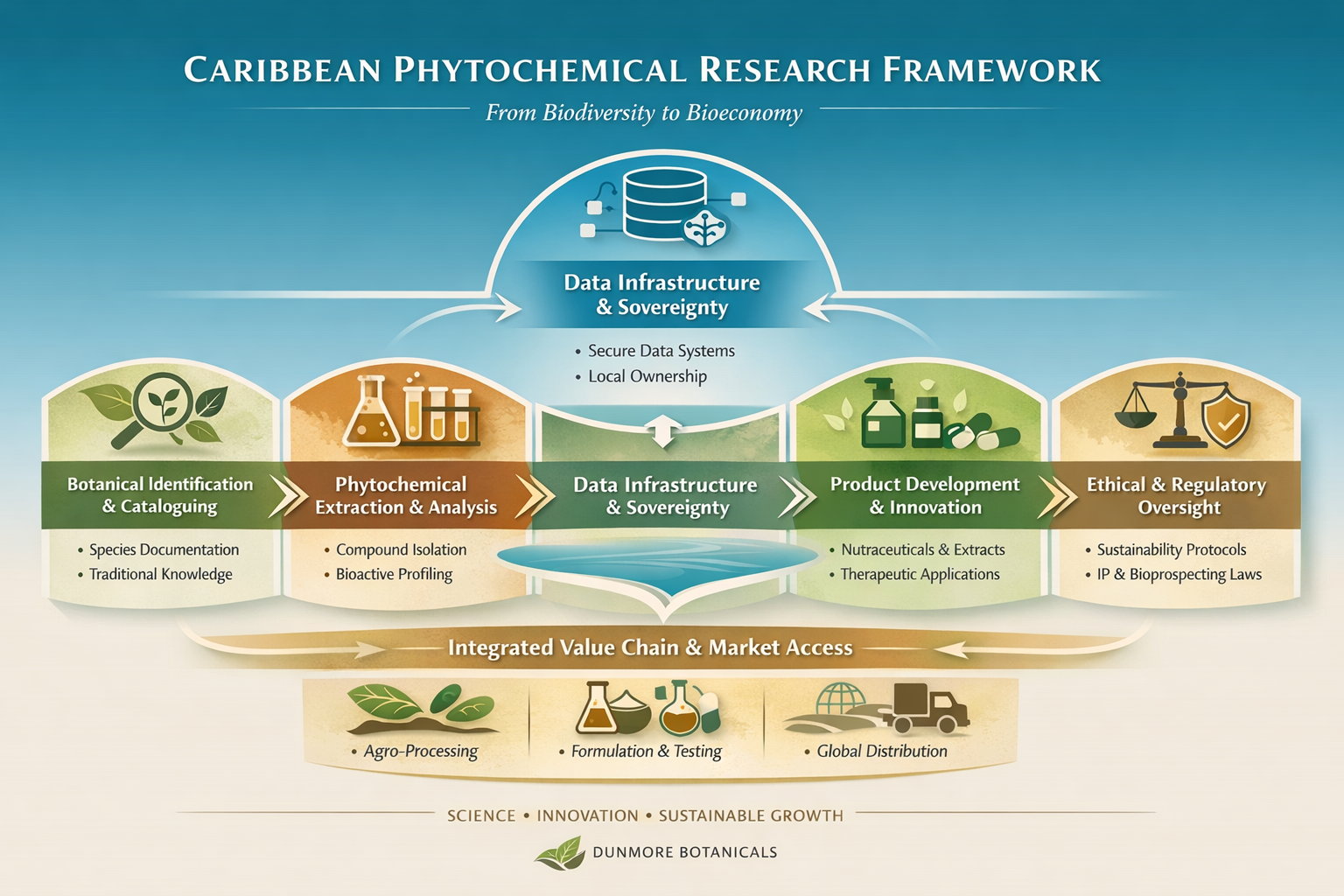
Core Components of a Phytochemical Framework
To fully capture this potential, a structured framework must be developed.
This includes:
1. Botanical Identification
Cataloguing plant species and traditional uses.
2. Phytochemical Research
Analyzing plant compounds and their applications.
3. Data Infrastructure
Capturing and managing biological data.
4. Product Development
Transforming research into usable outputs.
5. Governance & Ethics
Ensuring sustainability and fair use.
Infrastructure Before Industry
A key principle underpins this framework:
Before industry, there must be infrastructure.
This includes:
• Research systems
• Data systems
• Land-use frameworks
• Institutional coordination
Through ongoing work in land governance and agricultural development, it becomes clear that meaningful progress does not begin with activity—it begins with structure.
Without infrastructure, industry cannot scale.
With infrastructure, industry becomes sustainable.
Toward a New Industrial Evolution
The Caribbean now stands at the threshold of a new form of industrial development—one rooted in biology, data, and systems.
By integrating:
• Agriculture
• Science
• Technology
the region can transition from exporting raw materials to developing high-value products and intellectual assets.
This is not simply agricultural reform.
It is the foundation of a new bioeconomic era.
Conclusion
The transition from slavery to land ownership was a defining moment in Caribbean history.
The next transition must be:
• From ownership → to activation
• From land → to systems
• From production → to value creation
The opportunity exists.
The responsibility now is to build the systems required to realize it.